“We have the budget for it.”
In the executive suite, this phrase usually signals the end of a discussion. The funds are allocated, the vendor is selected, and the box is checked.
But as we look toward the complexities of 2026, money is becoming the least critical factor in organizational growth. The true bottleneck? Cognitive Bandwidth.
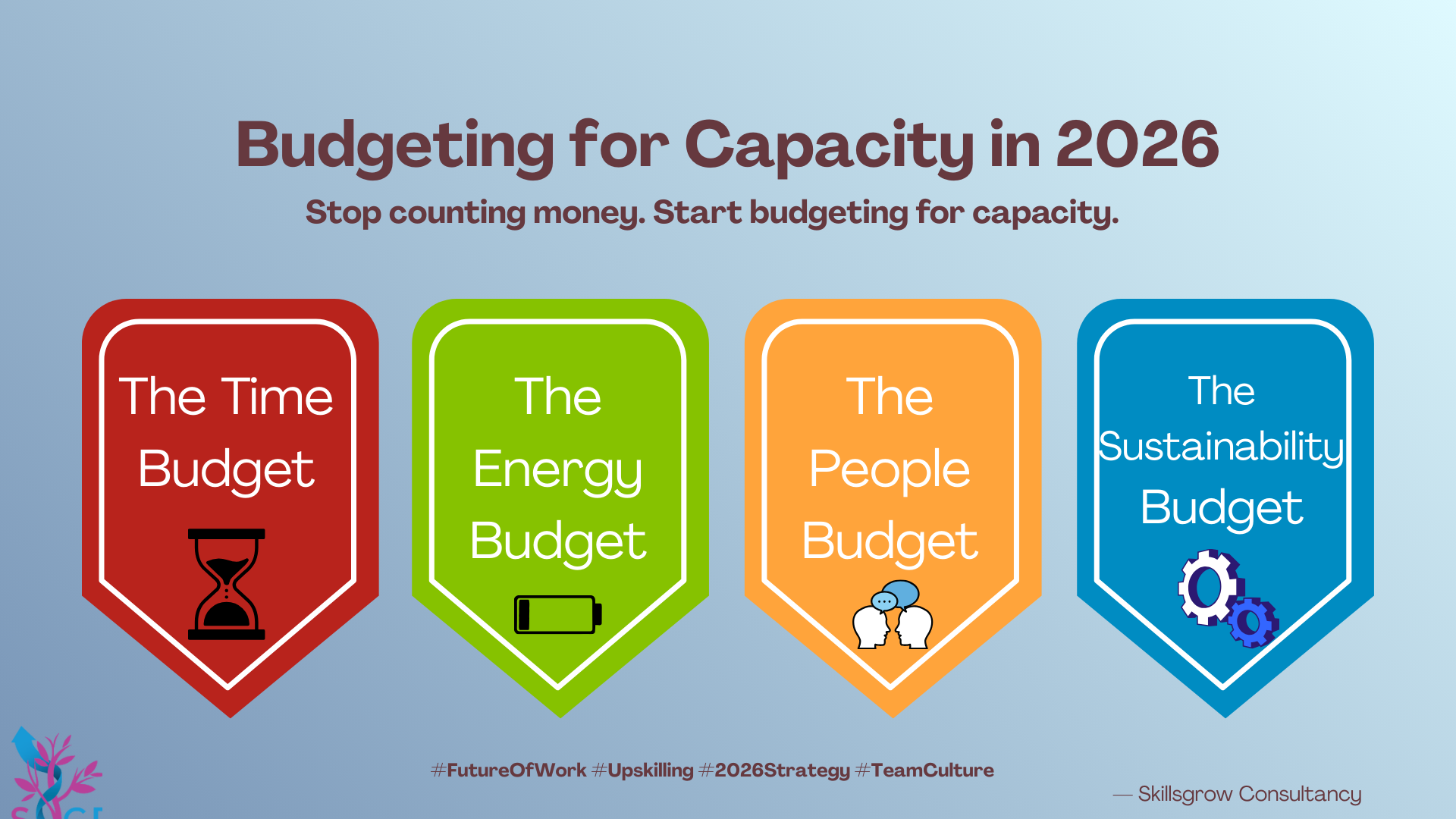
If you are currently drafting your 2026 roadmap, you must stop looking at dollar signs and start auditing the human cost of evolution. High performance isn’t an accident; it’s the result of an intentional allocation of four specific human currencies.
1. The Time Budget (The “White Space”)
When a leader buys a world-class training program but refuses to adjust current KPIs, they aren’t buying “upskilling.” They are buying burnout.
The Insight: Organizational psychologist Adam Grant has long championed the idea that “highly productive people don’t just have more time; they have more ‘white space’ for deep work.”
The Reality Check: Learning is work. If your team is at 100% utilization, their capacity to absorb new information is 0%.
- The Strategy: Protect learning blocks. If a training requires 5 hours a week, reduce that team’s deliverable load by 10% for the duration of the course.
2. The Energy Budget (The “Mental Tank”)
Cognitive science tells us that learning builds new neural pathways, which is physically and mentally exhausting. You cannot ask a team to innovate when they are in “survival mode.”
The Insight: Tony Schwartz, CEO of The Energy Project, argues that “energy, not time, is the fundamental currency of high performance.”
The Reality Check: If you schedule a high-intensity “AI Revolution” workshop immediately following a grueling Q3 launch, the information won’t stick. It will bounce off a fatigued workforce.
- The Strategy: Map your training calendar to your team’s energy cycles. Budget training for the lulls, not the peaks.
3. The People Budget (The “Support System”)
Skills do not exist in a vacuum; they exist in a culture. A $50,000 workshop will have zero ROI if the senior leadership doesn’t have the time to model, coach, and support the new behaviors.
The Insight: Harvard’s Amy Edmondson has proven that learning only happens in environments of Psychological Safety—where employees feel safe to be “new” (and therefore slow or imperfect) at a skill.
The Reality Check: Who is catching the mistakes during the learning curve? If your senior staff is too busy to mentor, the training will fail.
- The Strategy: Allocate “coaching hours” for senior players. Budget for the time it takes to teach, not just the cost of the student.
4. The Sustainability Budget (The “Messy Middle”)
Every new skill comes with a “dip”—a period where efficiency actually drops while the team unlearns old habits.
The Insight: This is the “Flywheel Effect” described by Jim Collins. The initial push for change is heavy, slow, and requires massive effort with little visible movement.
The Reality Check: Most leaders panic during this dip and pivot back to “the old way” because it feels safer.
- The Strategy: Build a “Sustainability Buffer.” Explicitly budget for a 15-20% dip in efficiency during the transition month. That “loss” is actually the down payment on exponential future speed.
Conclusion: Plan Early, Plan Intentionally
In 2026, the competitive advantage won’t belong to the company with the biggest training budget. It will belong to the leader who prepares their team to actually sustain the learning.
High performance isn’t a transaction you have with a vendor; it’s an environment you build with your team.
Next Steps for Leaders:
- Review your 2026 roadmap.
- Identify the “Learning Dips.”
- Ask your managers: “Do we have the capacity to learn this, or just the money to buy it?”
No responses yet