
On a quiet Friday afternoon, a CFO once leaned back in his chair and said:
“If you can’t quantify it, I can’t justify it.”
We were discussing Emotional Intelligence training.
He wasn’t dismissive.
He was cautious.
Because in finance, caution is survival.
But here’s the paradox:
The most expensive problems in organizations rarely begin as numbers.
They begin as emotions.
A sarcastic remark in a meeting.
An email sent in anger.
A manager who confuses authority with intimidation.
A high performer who silently disengages after months of feeling unheard.
None of these show up immediately on a balance sheet.
But give it time.
They become:
- Increased turnover
- Decreased productivity
- Client dissatisfaction
- Burnout-related absenteeism
- Culture decay
And suddenly… finance gets involved.
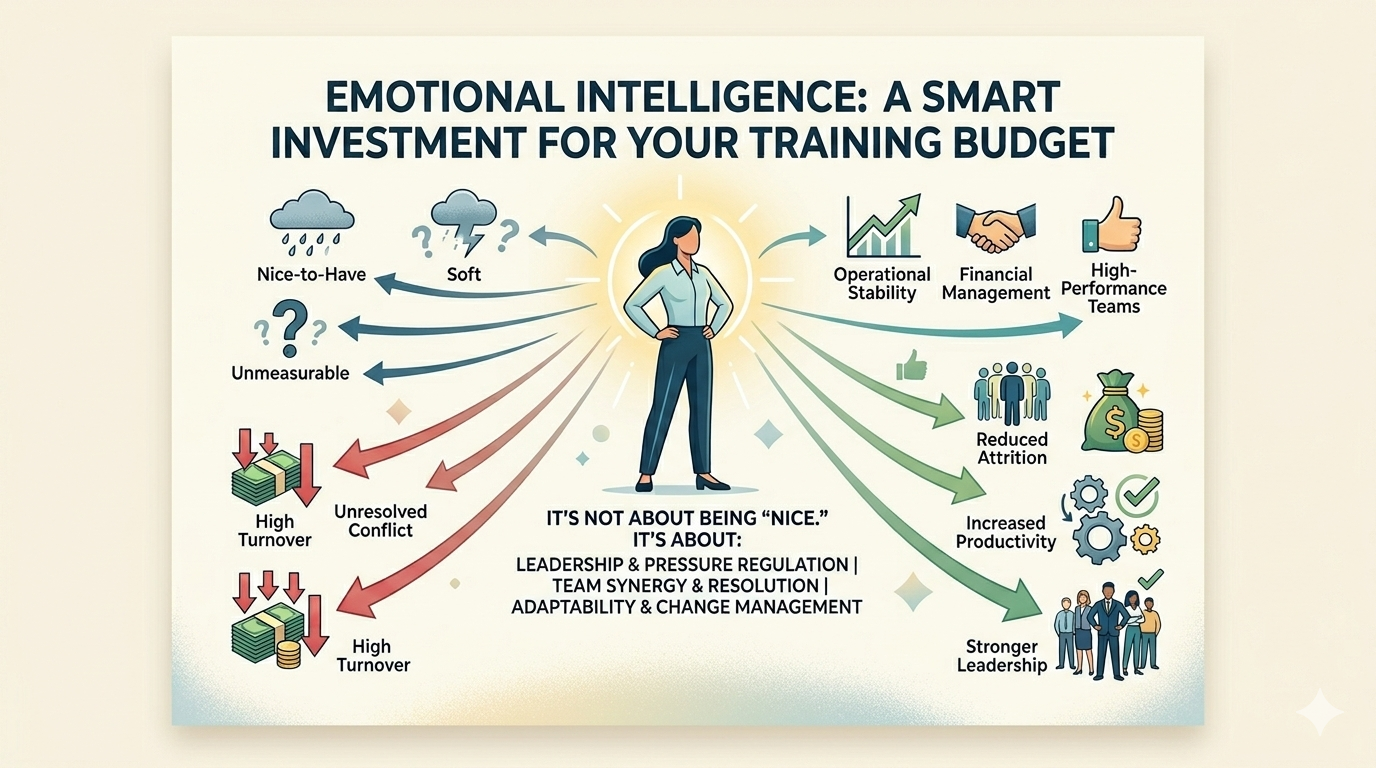
Emotional Intelligence (EI) is often misunderstood.
It is not about being agreeable.
It is not about suppressing hard conversations.
It is not about corporate group hugs.
It is about self-regulation under pressure.
It is about awareness — of self and others.
It is about choosing responses instead of reacting impulsively.
It is about leading adults without diminishing them.
When leaders lack EI, organizations pay for it quietly.
When leaders develop EI, organizations benefit loudly.
Consider this:
A technically brilliant manager who cannot manage emotions will eventually manage people poorly.
And poor people management is expensive.
Very expensive.
Training budgets are usually cut in tough seasons.
But the irony?
Tough seasons are when emotional capability matters most.
During restructuring.
During rapid growth.
During crisis.
During change management initiatives.
Emotional Intelligence becomes the stabilizer.
The shock absorber.
The difference between strategic adaptation and chaotic reaction.
Financial management is not just about reducing cost.
It is about protecting value.
Your people are value.
Their performance is value.
Their retention is value.
Their alignment is value.
And alignment is deeply emotional work.
At Skillsgrow Consultancy, we believe training budgets are not “spending.”
They are architecture.
When organizations invest in Emotional Intelligence development, they are:
- Reducing long-term risk
- Increasing leadership effectiveness
- Strengthening team resilience
- Enhancing decision-making quality
- Building cultures that sustain performance
And sustainable performance is the most powerful financial outcome of all.
The question is not:
“Can we afford Emotional Intelligence training?”
The real question is:
“Can we afford not to?”
If your organization is reviewing its training budget this quarter, we would love to help you design a program that strengthens both your people and your financial future.
Because smart financial management isn’t just about cutting costs.
It’s about investing wisely.
📩 Contact Skillsgrow Consultancy to design a tailored Emotional Intelligence training experience for your team.
Let’s build high-performance teams — intelligently.
No responses yet