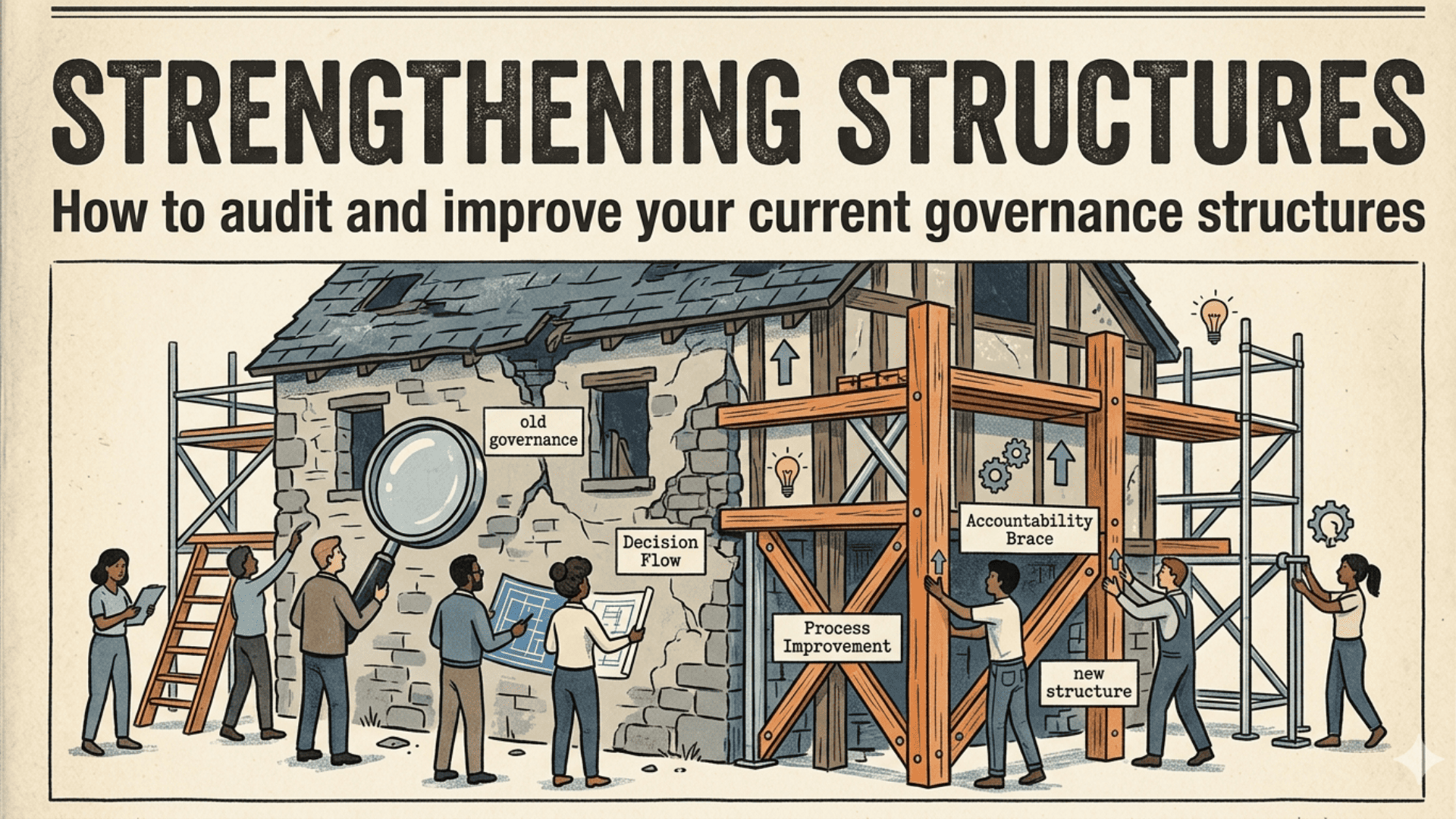
Think of your governance structure like the pipes in an old house.
When they’re working, nobody notices.
The water runs.
The coffee gets made.
Life moves.
But when those pipes clog…
—or worse, start leaking—
suddenly every room feels damp.
Uncomfortable.
Off.
That’s governance.
When it works, it’s invisible.
When it doesn’t, everyone feels it.
And if your team feels like they’re:
- wading through waist-deep bureaucracy
or - wandering in a lawless wilderness…
…it’s time for a governance audit.
Not to add more rules.
But to fix the pipes.
1. The “Mirror” Test
Start with reality.
Not the handbook.
Governance is simple:
How decisions are made—and who gets to make them.
So ask yourself:
If a crisis hit at 3:00 PM on a Tuesday…
who actually steps up?
Now—
is that the authorized person?
If those two don’t match,
you’ve got a leak.
Map the real flow of power.
Not the pretty org chart.
And don’t flinch at what you find.
2. The Clarity Audit
Most governance doesn’t fail loudly.
It fails… mushily.
And people hate mush.
They want edges.
Clear lines.
Defined ownership.
So ask:
- Who owns the final “yes”?
- Who needs to be consulted?
- And who is just CC’d… to keep the peace?
(That last one? That’s where time goes to die.)
Better governance isn’t about adding people.
It’s about removing confusion.
Sometimes the fix is simple:
Stop inviting everyone to everything.
Clarity is kindness.
Boundaries are structure.
3. From Control → Empowerment
Governance shouldn’t feel like a straitjacket.
It should feel like a guardrail.
If your rules exist only to prevent mistakes…
you’re suffocating your best people.
Shift the question:
From → “Did we follow every step?”
To → “Did we make a sound decision?”
High-performance teams don’t need more rules.
They need better principles.
Not a 10-step approval process…
…but clear values
and the trust to act on them.
Let experts be experts.
4. The Regular Tune-Up
Governance isn’t a slow cooker.
You can’t set it and forget it.
It’s a garden.
Things grow.
Things die.
And weeds? They will show up.
So check in—quarterly.
Ask your team:
- Where does work feel heavy?
- Where are decisions getting stuck?
- What rule made sense last year… but now just gets in the way?
Then adjust.
Audit with honesty.
Adjust with empathy.
Because governance isn’t just about efficiency.
It’s about giving people something powerful:
Clarity on how to win.
And that?
That’s the kind of structure people don’t fight.
They thrive in it.
👉 Be honest: are your systems supporting your people… or slowing them down?
No responses yet