Growth is often seen as proof that a business is moving in the right direction.
More clients.
More meetings.
More activity.
More people.
But inside many growing organisations, another reality quietly begins to unfold:
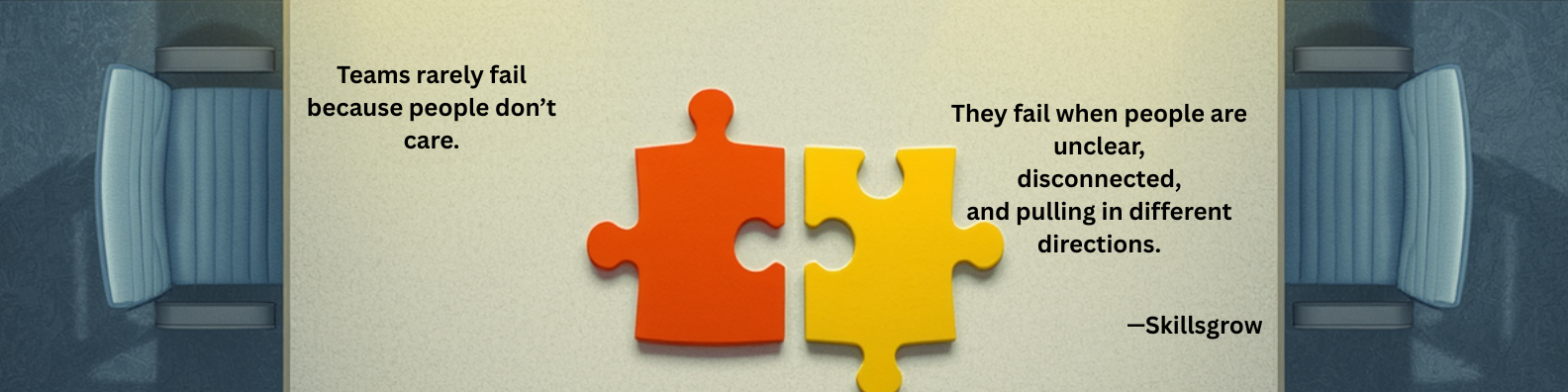
Teams working hard… while pulling in different directions.
And over time, that misalignment becomes expensive.
Not always in obvious ways.
But through:
- missed deadlines,
- repeated mistakes,
- communication gaps,
- slow decision-making,
- declining morale,
- and reduced productivity.
In many training rooms, the issue is rarely a lack of effort.
People are trying.
The challenge is often that teams are operating with:
- unclear priorities,
- inconsistent communication,
- different assumptions,
- or undefined ownership.
As businesses grow, the cracks become harder to ignore.
Processes that once worked informally begin to break down under pressure.
Tasks are duplicated.
Approvals slow things down.
Departments drift into silos.
From the outside, the business still appears functional.
Internally, however, friction begins to build.
What Misalignment Looks Like
Misalignment is rarely dramatic.
It shows up quietly in everyday operations:
- Teams leaving meetings without clarity
- Employees unsure who owns what
- Managers assuming expectations were communicated
- Departments moving toward different priorities
- Burnout despite constant activity
One common pattern in growing organisations is confusing busyness for effectiveness.
People are occupied all day, yet important work continues to move slowly.
As management expert Peter Drucker said:
“There is nothing so useless as doing efficiently that which should not be done at all.”
Without alignment, effort alone does not guarantee progress.
The Real Business Impact
Misalignment affects more than workplace atmosphere.
It affects execution.
When communication is unclear:
- projects slow down,
- decisions stall,
- accountability weakens,
- and frustration grows quietly within teams.
Over time, this impacts:
- customer experience,
- employee engagement,
- and overall business performance.
As Simon Sinek notes:
“A team is not a group of people who work together. A team is a group of people who trust each other.”
And trust struggles to grow where communication lacks clarity.
Misalignment also creates hidden financial costs through:
- repeated work,
- preventable mistakes,
- operational delays,
- and unnecessary pressure on teams.
Why Growing Businesses Feel It More
As organisations expand:
- communication becomes more complex,
- teams become more specialised,
- and alignment requires greater intentionality.
Without strong internal clarity:
- collaboration slows,
- culture weakens,
- and leadership visibility decreases.
This is why team development cannot remain an occasional activity.
It becomes part of sustainable business growth.
Building Better Alignment
Strong teams are not built through pressure alone.
They are built through:
- clear communication,
- defined expectations,
- accountability,
- leadership consistency,
- and shared understanding.
Alignment is not about making everyone think the same way.
It is about ensuring people understand:
- the goal,
- their role,
- and how their work connects to the bigger picture.
When that clarity exists, performance improves naturally.
Not because people suddenly work harder—
but because they are finally moving together.
Final Thought
Many businesses assume performance problems come from lack of motivation or skill.
But often, the deeper issue is simpler:
People cannot perform effectively in environments where clarity is missing.
Growing businesses do not only need ambitious goals.
They need aligned teams capable of moving toward those goals together.
At Skillsgrow Consultancy, these are some of the conversations continuing to emerge in training rooms across organisations and teams.
Because sustainable growth is not built by strategy alone.
It is built by people who understand how to work together effectively.
3 Responses
One thing we continue to notice in training rooms:
Most workplace friction is not caused by lack of effort.
It comes from unclear communication, assumptions, and teams operating without shared understanding.
Alignment changes more than productivity.
It changes how people experience work.
Growing businesses often focus on external growth first:
clients,
revenue,
expansion.
But internal alignment matters just as much.
Because when communication breaks down internally, performance eventually follows.
At Skillsgrow Consultancy, we believe high-performing teams are built intentionally.
Through:
clarity,
communication,
leadership,
and shared understanding.
Because sustainable growth is not only about scaling business—
it is also about strengthening the people behind it.