The workplace is changing quickly.
Teams today are navigating:
- faster communication,
- constant change,
- digital collaboration,
- growing workloads,
- and increasing pressure to adapt.
In that kind of environment, technical ability alone is no longer enough.
The strongest teams in 2026 will not simply be the most qualified.
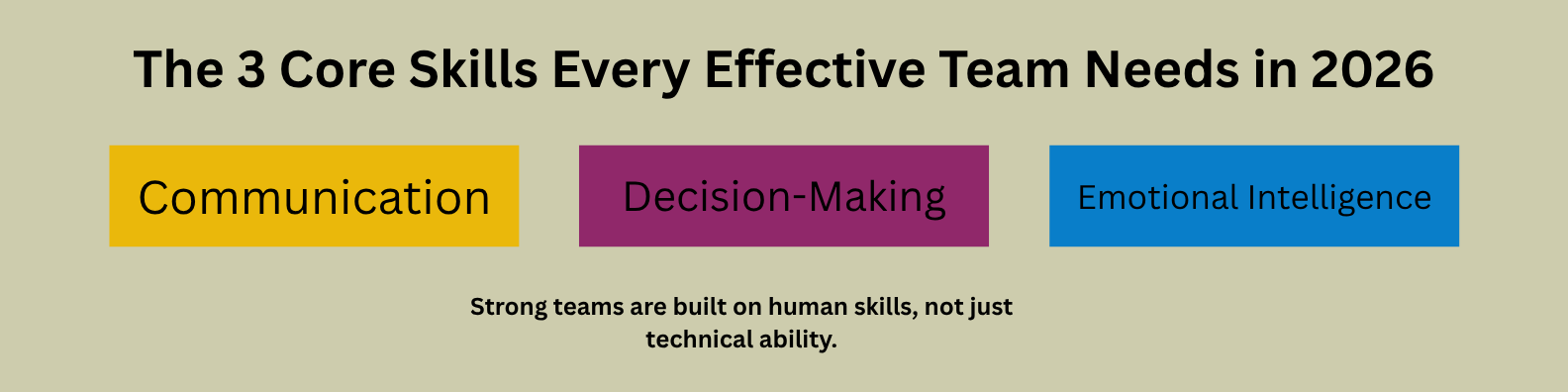
They will be the teams that communicate clearly, make effective decisions, and work well with people.
Because even the best strategy struggles in workplaces where communication breaks down, decisions stall, or tension goes unmanaged.
As Patrick Lencioni wrote in The Five Dysfunctions of a Team:
“Teamwork remains the ultimate competitive advantage, both because it is so powerful and so rare.”
And increasingly, that competitive advantage is built on human skills.
1. Communication
Most workplace problems do not begin with bad intentions.
They begin with unclear communication.
A missed update becomes a delayed task.
A misunderstood instruction creates repeated work.
Silence creates assumptions.
And assumptions eventually create frustration.
In many organisations, communication is treated as a basic skill people should already have.
But effective communication is far more intentional than simply passing information around.
It involves:
- clarity,
- listening,
- feedback,
- expectation setting,
- and knowing how to communicate under pressure.
As teams grow, communication gaps become more expensive.
Departments begin operating in silos.
Meetings increase, yet clarity decreases.
Employees spend more time clarifying work than executing it.
Research professor Brené Brown writes in Dare to Lead:
“Clear is kind. Unclear is unkind.”
That sentence explains a major challenge many workplaces face today.
People perform better when they understand:
- what is expected,
- what matters,
- and how to raise challenges early.
Strong communication reduces friction.
And teams with less friction move faster.
2. Decision-Making
Many teams do not struggle because they lack ideas.
They struggle because decision-making is slow, unclear, or concentrated in too few people.
Projects stall waiting for approvals.
Employees hesitate to act because ownership is unclear.
Leaders become overwhelmed because every decision depends on them.
Over time, this creates bottlenecks across the organisation.
High-performing teams approach decision-making differently.
They build cultures of:
- trust,
- accountability,
- critical thinking,
- and clarity around responsibility.
Good decision-making is not about rushing.
It is about knowing:
- what information matters,
- who is responsible,
- and when action is needed.
Management consultant Peter Drucker once said:
“Whenever you see a successful business, someone once made a courageous decision.”
In modern workplaces, indecision often becomes more costly than imperfect action.
Teams that can think critically and respond quickly are far better positioned to adapt and grow.
3. Emotional Intelligence
One of the biggest shifts happening in workplaces globally is the growing importance of emotional intelligence.
Today, employees are expected to do more than complete tasks.
They must also:
- collaborate,
- adapt,
- communicate,
- manage conflict,
- and work effectively with different personalities.
That requires emotional intelligence.
Emotional intelligence shapes how people:
- respond to pressure,
- handle disagreement,
- give feedback,
- navigate stress,
- and build trust within teams.
Technical skills may help someone secure a role.
But emotional intelligence often determines:
- leadership effectiveness,
- team cohesion,
- and long-term workplace success.
Psychologist Daniel Goleman explains in Emotional Intelligence:
“If your emotional abilities aren’t in hand… if you are not able to have empathy and effective relationships, then no matter how smart you are, you are not going to get very far.”
Emotionally intelligent teams tend to:
- communicate more openly,
- resolve issues faster,
- adapt better during change,
- and maintain healthier workplace relationships.
Stephen Covey also wrote in The 7 Habits of Highly Effective People:
“Strength lies in differences, not in similarities.”
Strong teams understand how to work through those differences productively instead of allowing them to create division.
Why These Skills Matter More in 2026
Automation and technology will continue reshaping technical work.
But communication, decision-making, and emotional intelligence remain deeply human skills.
And as workplaces become more interconnected, those skills become even more valuable.
They help teams:
- collaborate effectively,
- navigate uncertainty,
- solve problems faster,
- and maintain strong working relationships under pressure.
Businesses that invest in these skills are not simply improving workplace culture.
They are strengthening long-term performance.
Final Thought
Many organisations focus heavily on systems, targets, and productivity metrics.
And those things matter.
But behind every successful workplace are people trying to work together effectively.
That is why the future of high-performing teams will not depend only on technical expertise.
It will depend on people who know how to:
- communicate clearly,
- make sound decisions,
- and work well with others.
At Skillsgrow Consultancy, these are some of the conversations continuing to emerge across training rooms and team development sessions.
Because strong teams are not built by talent alone.
They are built by people who understand how to work together effectively.
No responses yet